≋ · ▭ · ◎ · ╫ · ⊙ · ϕ · ⌢ · ◉ · ▽

Ostrvo

Chef's Table · AsketCuisine · 2026 Chef's Table · AsketCuisine · 2026

Nine courses at one table.
What the sea and the island give,
cooked with care.
Devet hodova za jednim stolom.
Ono što daju more i ostrvo,
skuvano pažljivo.
← Home · AsketCuisine← Početna · AsketCuisine

PhilosophyFilozofija
AsketCuisine

I often tell the cooks I work with that good prep is what keeps a kitchen calm. When service starts, what was prepared beforehand either holds or it doesn't, and you see it on the plate.

AsketCuisine is how I write down and run a kitchen: what goes in, what we do to it and what ends up on the plate. Chef's Table is the first place where this way of working meets guests, at one table.

The island is where the sea reaches the shore before dawn and the wind smells of salt and herbs. An ingredient that grows on stone, with sea salt and sun, has a taste of its own. Technique is there to keep it, not to add to it.

Many guests come to the island by boat or yacht, from Vienna, Hamburg, Stockholm or Milan. Some have eaten at Amador in Vienna, at Noma in Copenhagen, at Frantzén in Stockholm, and know what an oyster chip or binchotan charcoal is. They are not looking for the exotic, but for a dish that has a reason to be here.

Chef's Table Ostrvo is my attempt to cook that: few elements, produce from the island and the sea, texture you can feel. This page is more than a menu. It is where I wrote down how I thought: why these ingredients, why in this order, why one course is cold and not warm, sour and not sweet, quiet and not loud.

Kuvarima s kojima radim često kažem da je dobra priprema ono što kuhinji daje mir. Kad servis počne, ono što je spremljeno unapred ili drži ili ne drži, i to se vidi na tanjiru.

AsketCuisine je način na koji zapisujem i vodim kuhinju: šta ulazi, šta se s tim radi i šta ostaje na tanjiru. Chef's Table je prvo mesto gde taj način rada izlazi pred goste, za jednim stolom.

Ostrvo je mesto gde more stiže do obale pre svitanja, a vetar miriše na so i bilje. Namirnica koja raste na kamenu, uz morsku so i sunce, ima svoj ukus. Tehnika tu ne treba da dodaje, nego da sačuva ono što namirnica već ima.

Mnogi gosti dolaze na ostrvo brodom ili jahtom, iz Beča, Hamburga, Stokholma ili Milana. Neki su jeli kod Amadora u Beču, u Nomi u Kopenhagenu, kod Frantzéna u Stokholmu, i znaju šta je čips od kamenice ili binchotan ugalj. Ne traže egzotiku, nego jelo koje ima razloga da bude baš ovde.

Chef's Table Ostrvo je moj pokušaj da se to skuva: malo elemenata, namirnice sa ostrva i iz mora, tekstura koja se oseća. Ova strana je više od jelovnika. Ovde sam zapisao kako sam razmišljao: zašto baš te namirnice, zašto tim redom, zašto je neki hod hladan a ne topao, kiseo a ne sladak, tih a ne glasan.


MethodMetoda
Nine courses · One eveningDevet hodova · Jedno veče

AsketCuisine writes a dish as an equation: the ingredient (Terra), the transformation with its numbers (Ars), the plate in places — anchor, base, sauce, sharpness, crust, breath — and one law of balance, Modus: subtract to the essence. The same equation runs the kitchen: purchasing and pantry, the stations, the tasting, the table.

Then I thought the same equation could put together a dinner, not just a plate. Each course carries one part of it, and the guest doesn't have to read anything, just eat: the ingredient as it is, one ingredient three ways, the sauce, the anchor, fire, the cut, time, the essence and what stays. At each place there is a card with nine symbols and one sentence. That is all that is said before dinner. Each course comes with one more short sentence, not a lecture.

AsketCuisine piše jelo kao jednačinu: namirnica (Terra), preobražaj sa brojevima (Ars), tanjir u mestima (sidro, osnova, sos, oštrina, kora, dah) i jedan zakon ravnoteže, Modus: oduzmi do suštine. Ista jednačina vodi kuhinju: nabavka i ostava, stanice, proba, sto.

Onda sam pomislio da ista jednačina može da složi i večeru, ne samo tanjir. Svaki hod nosi jedan njen deo, a gost ne mora ništa da čita, samo jede: namirnica kakva jeste, jedna namirnica na tri načina, sos, sidro, vatra, rez, vreme, suština i ono što ostaje. Na svakom mestu za stolom stoji kartica sa devet simbola i jednom rečenicom. To je sve što se kaže pre večere. Uz svaki hod ide još po jedna kratka rečenica, ne predavanje.

≋
Bura
TerraTerra
Oyster · focaccia · fennelKamenica · fokača · komorač
▭
Masa
[V] Variations[V] Varijacije
Sardine · Adriatic seaSrdela · Jadransko more
◎
Esenca
IusIus
Mussel · localDagnja · lokalna
╫
Kostra
AncoraAncora
Dentex · Dentex dentexZubatac · Dentex dentex
⊙
Žara
Ars · fireArs · vatra
Octopus · Adriatic seaHobotnica · Jadransko more
ϕ
Ferment
AcorAcor
Fennel · local farmKomorač · lokalni uzgoj
⌢
Patina
Ars · timeArs · vreme
Lamb · island-raisedJagnjetina · ostrvo
◉
Jezgra
ModusModus
Fig · islandSmokva · ostrvska
▽
Talog
ConservationOdržanje
Olive oil · EVOMaslinovo ulje · EVO

MenuJelovnik
Nine courses · One eveningDevet hodova · Jedno veče
≋
01

Bura

Terra · The ingredient as it isTerra · Namirnica kakva jeste
Oyster · focaccia · fennel mignonetteKamenica · fokača · mignonette od komorača
Bura

Večera počinje namirnicom koja se ne kuva, samo se otvori. Kamenica stiže na sto dok gosti tek sedaju, bez menija i bez objašnjenja. Uz nju ide jedna rečenica: Pre svega, more. Gost dolazi sa broda, sa plaže, iz razgovora, sa aperitiva. Kamenica ga vrati u trenutak: hladno, slano, oštar ukus Jadrana.

Jedna kamenica na poluljusci, tek otvorena, na malo drobljenog leda. Pored nje tanak rez fokače s maslinama, kratko na grilu: topao, krhak spolja, mekan iznutra. I kašika mignonette-a od komorača, limete i šalota: kiselo, sveže, oštro. More, zemlja, kiselina. Gost popije kamenicu, zagrize fokaču, a mignonette spoji jedno s drugim ili ostane netaknut. Terra ne pokazuje tehniku, nego namirnicu kakva jeste.

Kamenica: jadranska, otvorena u momentu servisa, nikad ranije. Čisti se pod tekućom hladnom vodom, mišić se odvoji nožem za kamenice, tečnost se zadrži u ljusci. Servira se na drobljenom morskom ledu. Fokača s maslinama: testo od brašna tip 0, maslinovog ulja, vode, kvasca, morske soli i crnih maslina (taggiasca ili domaće). Mesi se dan ranije, fermentira 12–18 sati u frižideru. Peče se ujutro na 220°C, 18–20 minuta. Seče se na tanke rezove (3mm) i tostira na grilu ili u rerni na 180°C 2–3 minuta pred servis. Mignonette od komorača: sitno seckan svež komorač iz lokalnog uzgoja (ubran dan ranije), sok i korica limete, sitno seckan šalot, malo belog vinskog sirćeta, prstohvat morske soli. Meša se 1–2 sata pre servisa, drži u frižideru.

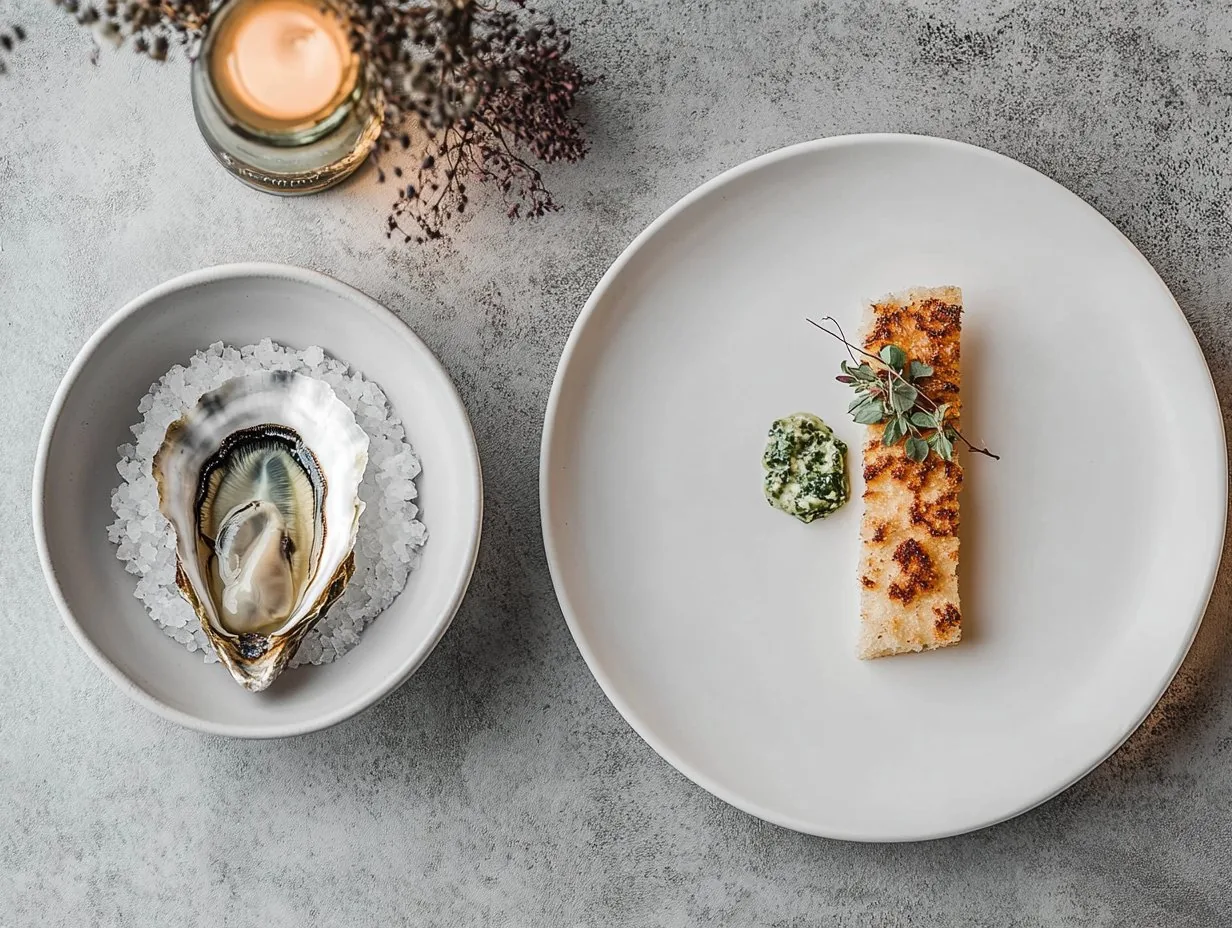
The dinner begins with an ingredient that is not cooked, only opened. The oyster arrives as guests are sitting down, with no menu and no explanation. One sentence comes with it: Before anything else, the sea. Guests come from the boat, the beach, a conversation, an aperitivo. The oyster brings them into the moment: cold, salty, the sharp taste of the Adriatic.

One oyster on the half shell, just opened, on a little crushed ice. Beside it a thin slice of olive focaccia, briefly grilled: warm, crisp outside, soft inside. And a spoonful of mignonette made from fennel, lime and shallot: sour, fresh, sharp. Sea, earth, acid. The guest drinks the oyster, bites the focaccia, and the mignonette ties them together or stays untouched. Terra does not show technique, only the ingredient as it is.

Oyster: Adriatic, opened at the moment of service, never before. Cleaned under cold running water, muscle detached with an oyster knife, liquor retained in the shell. Served on crushed sea ice. Olive focaccia: dough of tipo 0 flour, olive oil, water, yeast, sea salt and black olives (taggiasca or local). Mixed the day before, cold-fermented 12–18 hours. Baked in the morning at 220°C for 18–20 minutes. Sliced thin (3mm) and toasted on a grill or in the oven at 180°C for 2–3 minutes before service. Fennel mignonette: finely chopped fresh fennel from a local farm (picked the day before), lime juice and zest, finely diced shallot, a touch of white wine vinegar, pinch of sea salt. Mixed 1–2 hours before service, kept refrigerated.

raw oystersirova kamenicaolive focacciafokača s maslinamamignonette
Classical French (mignonette) · Mediterranean bread tradition (focaccia) · Raw service (Adriatic)Klasična francuska (mignonette) · Mediteranska tradicija hleba (fokača) · Sirovi servis (Jadran)
Before anything else, the sea.Pre svega, more.
▭
02

Masa

[V] Variations · One ingredient, three reactions[V] Varijacije · Jedna namirnica, tri reakcije
Sardine · Adriatic seaSrdela · Jadransko more
Masa

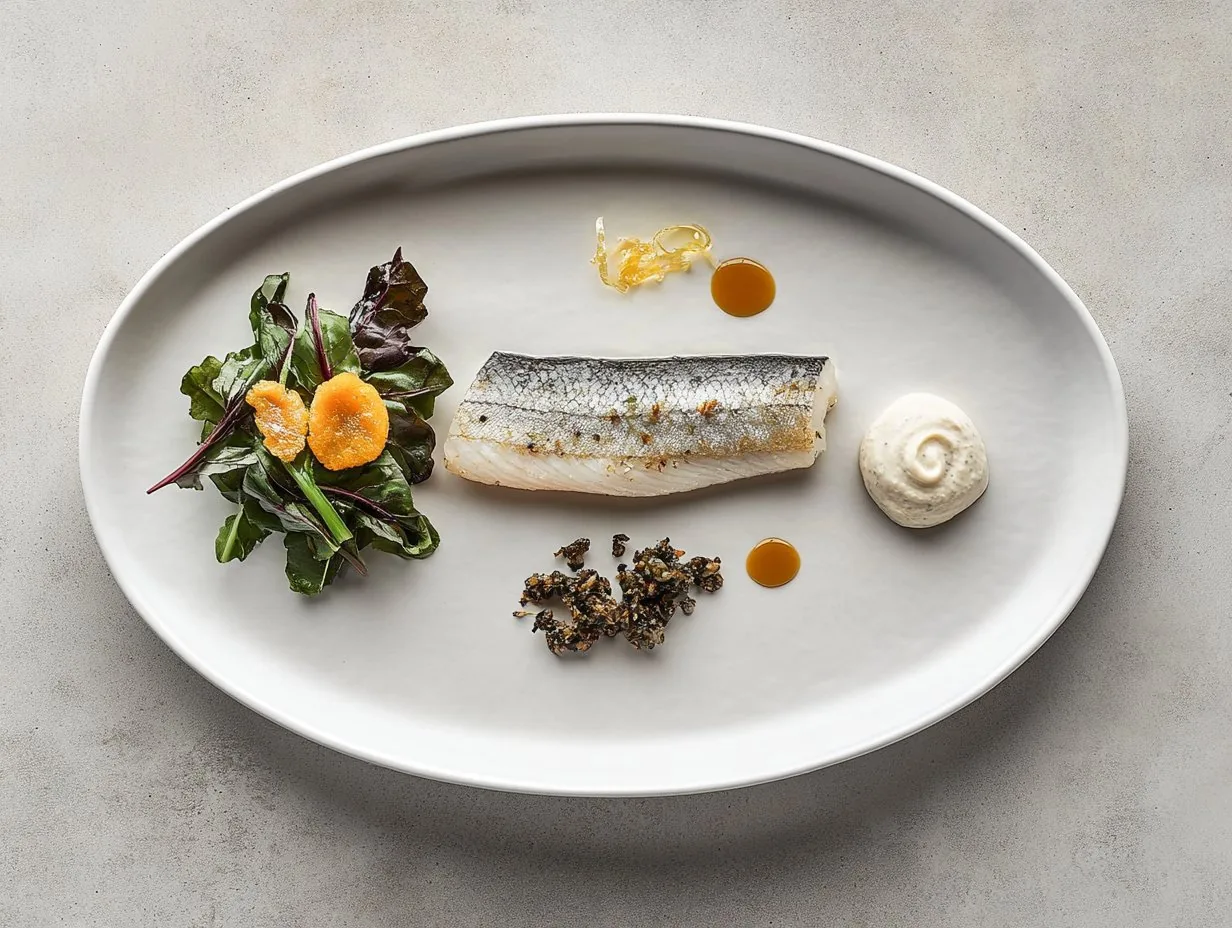
Varijacije: jedna namirnica, tri reakcije. Srdela je skromna riba, ali ima masnoću koju je teško zameniti. Citrus gravlax je otvori, dim je zaokruži, a koža postane čips. Gost proba istu ribu tri puta i svaki put je oseti malo drugačije.

Citrus gravlax: filet srdele 24 sata u mešavini soli, šećera i kore limuna i narandže. So i šećer izvuku vodu, meso se zategne, a ostane nežno. Dimljena krema od srdele: hladno dimljenje 45 minuta, zatim emulzija s maslinovim uljem, kaparima i limunom, nešto između paštete i musa. Čips od kože: koža pržena dok ne postane hrskava, tanka kao pergament. Gost proba sve tri i sam zaključi.

Variations: one ingredient, three reactions. The sardine is a humble fish, but its fat is hard to replace. Citrus gravlax opens it up, smoke rounds it off, and the skin becomes a chip. The guest tastes the same fish three times and finds it a little different each time.

Citrus gravlax: sardine fillet cured for 24 hours in salt, sugar and lemon and orange zest. Salt and sugar draw out water, so the flesh firms up but stays tender. Smoked sardine cream: cold-smoked for 45 minutes, then emulsified with olive oil, capers and lemon, somewhere between pâté and mousse. Skin chip: the skin fried until crisp, thin as parchment. The guest tastes all three and decides for themselves.

citrus gravlaxsmoked creamdimljena kremaskin chipčip
Frantzén (gravlax, nordijska tradicija) · Dahlgren (hladno dimljenje / cold smoking) · Alajmo
A humble fish, done with care.Skromna riba, urađena pažljivo.
◎
03

Esenca

Ius · The sea in a cupIus · More u šolji
Mussel · locally raisedDagnja · lokalno uzgojena
Esenca

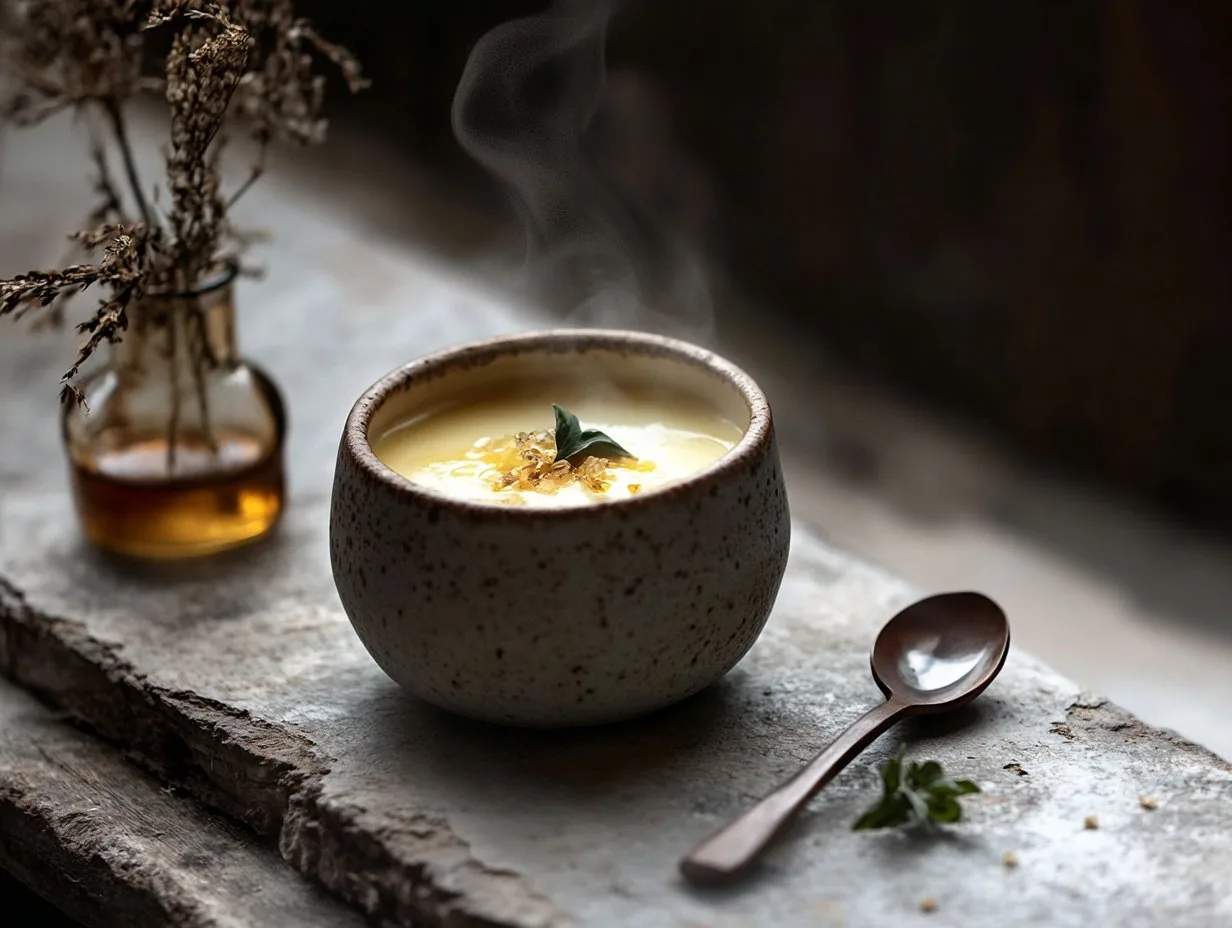
Topli konsomé od dagnje je predah: topla, mineralna tečnost posle dva hladna hoda. U prvoj verziji jelovnika posle kamenice i srdele odmah je dolazio zubatac, tri sirova ili soljena morska jela zaredom. Probao sam to na sebi i kod trećeg sam već tražio pauzu. Zato je na treće mesto došao topli konsomé, more u šolji, pa tek onda sidro večeri.

Konsomé se bistri klasično, belim raftom od dagnji, jer riblji raft daje čistiji ukus od mesnog. Kocke agar gela nose isti ukus u drugom obliku: topla tečnost u šolji i hladan gel na kašičici koji se topi u ustima. Isti ukus, dve temperature. Espuma na površini je treći, najnežniji sloj.

The warm mussel consommé is a breather: a warm, mineral liquid after two cold courses. In the first version of the menu, dentex came straight after the oyster and the sardine, three raw or cured sea courses in a row. I tried it on myself, and by the third I wanted a pause. So a warm consommé took third place, the sea in a cup, and only then comes the anchor of the evening.

The consommé is clarified the classic way, with a white raft made from mussels, because a fish raft gives a cleaner taste than a meat one. Agar gel cubes carry the same taste in another form: warm liquid in the cup, cold gel on the spoon that melts in the mouth. Same taste, two temperatures. Espuma on top is the third and lightest layer.

consomméespumaagar gel
Escoffier (raft clarification) · Adrià (espuma) · Blumenthal (agar, kontrast temperatura / temperature contrast)
A warm cup and a cold gel, one taste.Topla šolja i hladan gel, isti ukus.
╫
04

Kostra

Ancora · The anchor that carriesAncora · Sidro koje nosi
Dentex · Dentex dentex, Adriatic seaZubatac · Dentex dentex, Jadransko more
Kostra

Zubatac mi je drag jer je pouzdan: meso je čvrsto, belo i sočno, i podnosi težinu koju sidro večeri mora da nosi. Dolazi četvrti, posle toplog konsomea. Konfit u maslinovom ulju je bogat hod i bez tog predaha mogao bi da bude pretežak. Ovako dolazi u pravom trenutku.

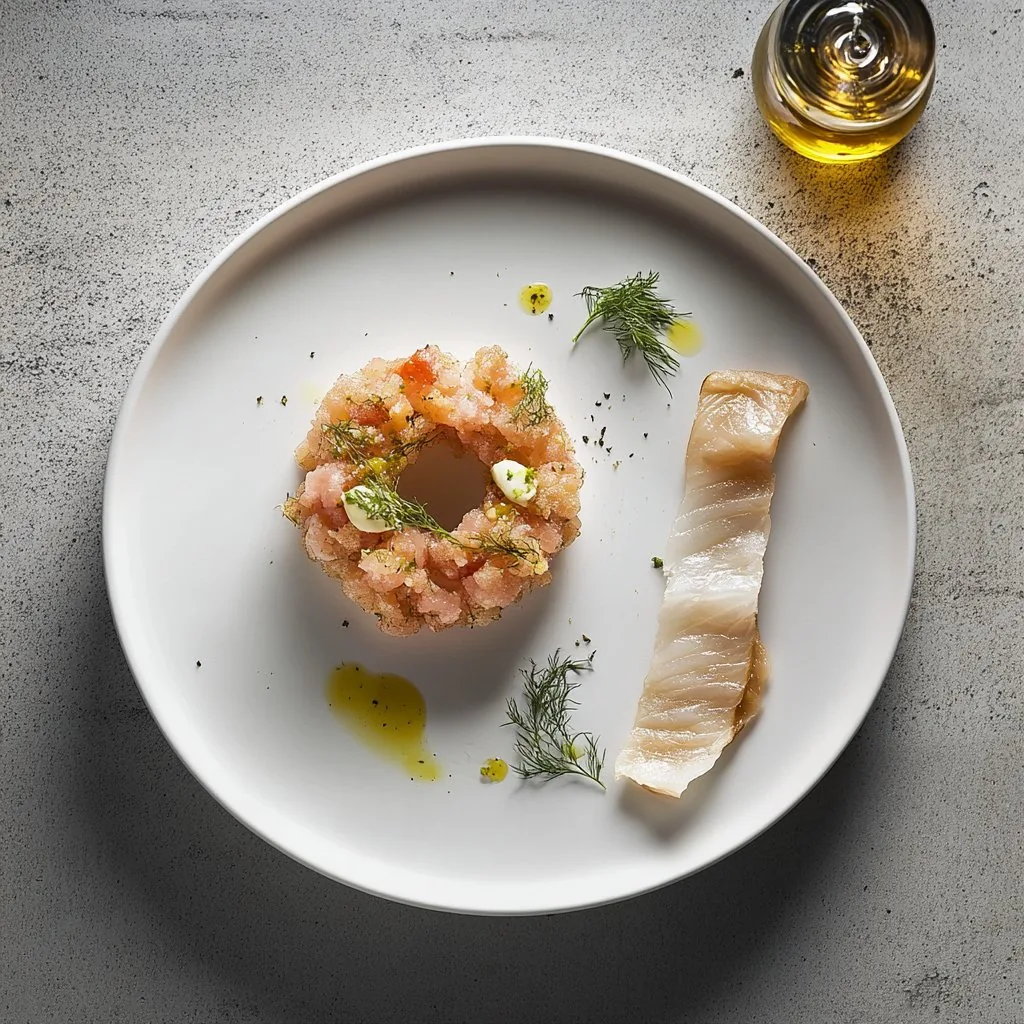
Tartar se seče nožem, brunoise 3–4 mm, nikad blenderom: tekstura treba da se vidi, da ne bude pasta. Začini se maslinovim uljem, korom limuna, prstohvatom morske soli i kapljicom ponzua. Odozgo ide disk agar gela od ribljeg temeljca iz Esence, gladak kao ogledalo. Konfit u maslinovom ulju na 52°C: proteini se menjaju, a kolagen ostaje nežan, negde između sirovog i kuvanog. Naduvana koža: koža zubaca sušena 24 sata, pa pržena u ulju na 190°C dok ne nabubri kao jastučić. Jako hrskava.

I like dentex because it is reliable: the flesh is firm, white and juicy, and it can carry the weight the anchor of the evening has to carry. It comes fourth, after the warm consommé. Confit in olive oil is a rich course, and without that breather it could be too heavy. This way it arrives at the right moment.

The tartare is cut by hand, brunoise 3–4 mm, never in a blender: the texture should be visible, not a paste. Seasoned with olive oil, lemon zest, a pinch of sea salt and a drop of ponzu. On top goes a disc of agar gel made from the fish broth of the Esenca course, smooth as a mirror. Confit in olive oil at 52°C: the proteins change while the collagen stays tender, somewhere between raw and cooked. Puffed skin: dentex skin dried for 24 hours, then fried in oil at 190°C until it puffs up like a little pillow. Very crisp.

tartareconfit 52°Cpuffed skinnaduvana koža
Bottura (minimum sauce, maximum product) · Robuchon / Blumenthal (niska temperatura / low temperature) · japanska kaiseki tradicija (koža / skin)
One dentex, three ways.Jedan zubatac, tri načina.
⊙
05

Žara

Ars · fire · Transformation with a numberArs · vatra · Preobražaj sa brojem
Octopus · Adriatic seaHobotnica · Jadransko more
Žara

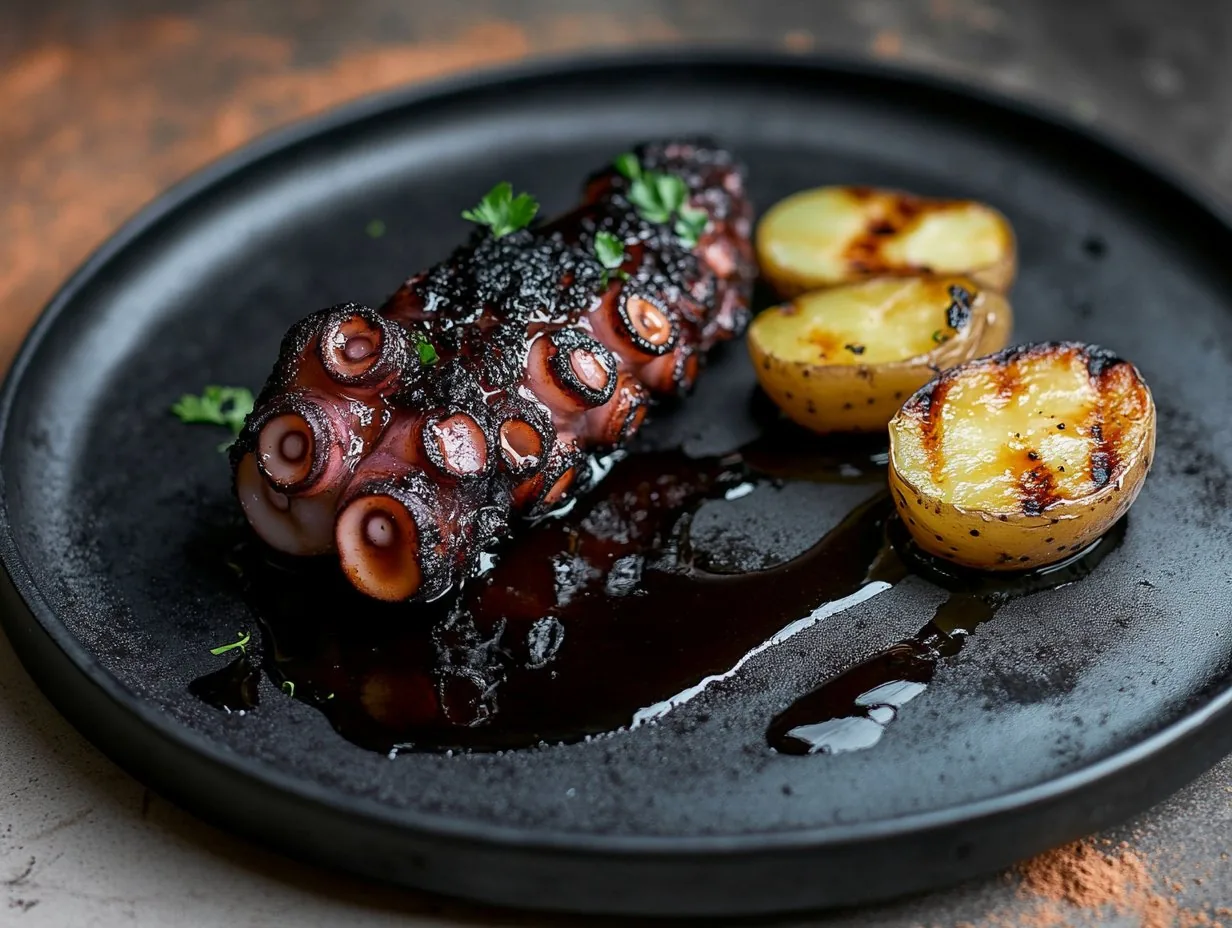
Žara je hod vatre. Za hobotnicu biram binchotan: ugalj gori na 700°C i daje toplotu bez dima i mirisa. Tu se ugledam na Asador Etxebarri: dobroj namirnici i dobroj vatri ne treba mnogo više. Prva 4 sata hobotnica se kuva na tihoj vatri, dok kolagen ne postane želatin koji drži teksturu. Onda ide na binchotan: spolja crna, unutra mekana.

Umami redukcija uz ovaj hod pravi se od povrća i ljuštura, bez mesa i bez ribe. Beli pasulj karamelizovan na jakoj vatri 12–15 minuta. Paradajz ugljenisan direktno na plamenu, neoguljen: zagoreli trag je deo ukusa. Kupus karamelizovan do tamnosmeđe boje u suvoj tavi, bez ulja. Ljušture dagnji i kamenica tostirane u suvoj tavi daju mineralni ukus mora. Sve se redukuje na trećinu i emulguje maslinovim uljem. Dobije se tamna, sjajna emulzija koja u ustima podseća i na vatru i na more.

Žara is the course of fire. For octopus I choose binchotan: the charcoal burns at 700°C and gives heat without smoke or smell. Here I follow Asador Etxebarri: good produce and a good fire need little else. For the first 4 hours the octopus cooks over a low flame, until the collagen turns into gelatin that holds the texture. Then it goes onto the binchotan: black outside, tender inside.

The umami reduction for this course is made from vegetables and shells, with no meat and no fish. White beans caramelised over high heat for 12–15 minutes. Tomatoes charred directly over the flame, unpeeled: the burnt marks are part of the taste. Cabbage caramelised to dark brown in a dry pan, without oil. Mussel and oyster shells toasted in a dry pan give a mineral taste of the sea. Everything is reduced to a third and emulsified with olive oil. The result is a dark, glossy emulsion that tastes of both fire and sea.

braised 4hbinchotan + umamiwafer / inktinta
Asador Etxebarri (binchotan filozofija / philosophy) · Noma (morska fermentacija / sea fermentation) · elBulli (wafer, tinta / ink)
Octopus from the coals, the evening's taste of fire.Hobotnica sa žara, ukus vatre u večeri.
ϕ
06

Ferment

Acor · The cutAcor · Rez
Fennel · local farm, picked the day beforeKomorač · lokalni uzgoj, ubran dan ranije
Ferment

Odmah posle vatre dolazi rez. Posle tamne, bogate hobotnice sa žara gost dobija nešto ledeno, kiselo i zeleno, s mirisom svežeg komorača iz lokalnog uzgoja. Nepce se osveži. Ovaj hod je tu samo zbog toga.

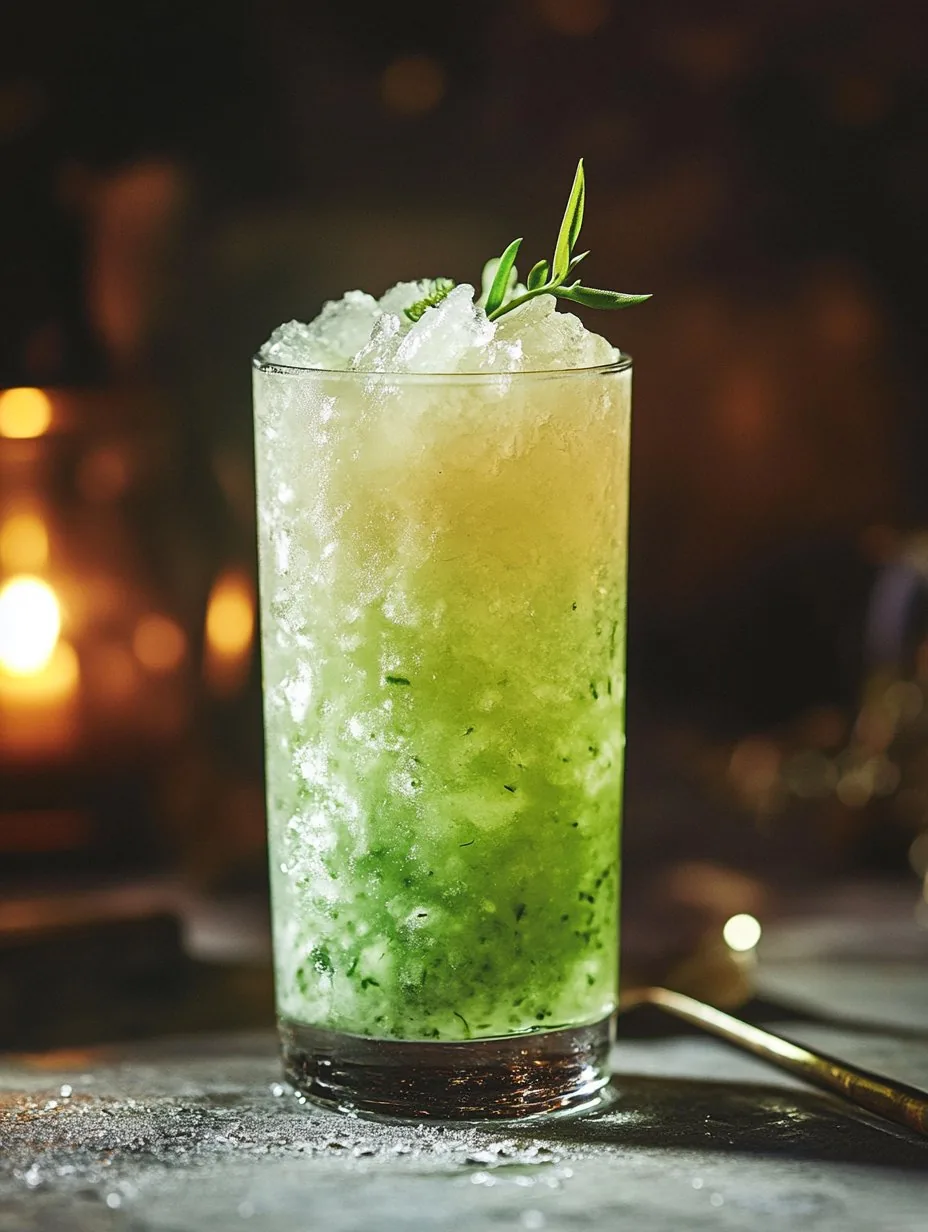
Porcija je manja od svih pre nje: ovaj hod ne treba da zasiti, nego da probudi. Agua fresca od svežeg komorača: sok isceđen rukom kroz muslin, s limunom i morskom soli, u visokoj uskoj čaši na 2–4°C. Lakto granita: komorač fermentisan 4–5 dana sa 2% soli, kao u Nomi, zamrznut i izgreban u granitu koja se topi brže nego što gost stigne da je pojede, i baš to je cilj. Krema od pepela komorača: listovi spaljeni do belog pepela, pomešani s maslinovim uljem i morskom soli. Od Redzepija: biljka se koristi do kraja, čak i kao pepeo.

Right after the fire comes the cut. After the dark, rich octopus from the coals, the guest gets something icy, sour and green, smelling of fresh fennel from a local farm. The palate wakes up. That is all this course is for.

The portion is smaller than any before it: this course is meant to wake you up, not fill you. Agua fresca of fresh fennel: juice pressed by hand through muslin, with lemon and sea salt, in a tall narrow glass at 2–4°C. Lacto granita: fennel fermented for 4–5 days with 2% salt, as at Noma, frozen and scraped into a granita that melts faster than the guest can eat it, which is the point. Ash cream from the fennel plant: leaves burned to white ash, mixed with olive oil and sea salt. From Redzepi: use the plant all the way, even as ash.

agua frescalacto granitaash creamkrema od pepela
Noma / Zilber (lacto-fermentacija / Wild Fermentation) · Redzepi (pepeo i ugalj / ash and char as flavour)
Sour and cold, to rest the palate.Kiselo i hladno, da se nepce odmori.
⌢
07

Patina

Ars · time · What time doesArs · vreme · Ono što radi vreme
Lamb · island-raised · sage and sea saltJagnjetina · sa ostrva · žalfija i morska so
Patina

Jagnjetina sa ostrva nosi ukus ostrva: kamena, divlje žalfije uz puteve i soli koju vetar donosi s mora. Ali u ovom hodu glavni posao radi vreme: 48 sati sous-vide na 72°C, dok kolagen ne postane želatin. Ovde Ars nije vatra, nego vreme. Hod je težak, jer treba da zaokruži sve što je bilo pre njega. Namerno dolazi posle najduže pauze u večeri, 22–25 minuta, da gosti malo porazgovaraju i ponovo ogladne.

Na kraju ide na binchotan, koji mu da tamnu koru, a meso unutra ostane meko. Ispod presovane plećke ide ista umami redukcija kao uz hobotnicu, samo ovde radi drugi posao. Mast se razlije u tanak sloj od 1,5–2 mm, ohladi dok se ne stegne, iseče na pravougaonike i prži u ulju na 180°C, 45–60 sekundi, dok ne postane providna i hrskava. Od glave do repa, u jednom zalogaju. Gostima se pri rezervaciji kaže šta je to: jagnjeća mast, hrskava.

Island lamb tastes of the island: the stone, the wild sage along the roads, the salt the wind brings from the sea. But in this course time does the main work: 48 hours sous-vide at 72°C, until the collagen turns to gelatin. Here Ars is not fire but time. It is a heavy course, because it has to round off everything before it. It comes on purpose after the longest pause of the evening, 22–25 minutes, so guests can talk a little and get hungry again.

At the end the binchotan gives it a dark crust, while the meat stays tender inside. Under the pressed shoulder goes the same umami reduction as with the octopus, doing a different job here. The fat is spread into a thin layer of 1.5–2 mm, chilled until firm, cut into rectangles and fried in oil at 180°C for 45–60 seconds, until translucent and crisp. Nose to tail, in one bite. Guests are told at booking what it is: lamb fat, crisp.

48h sous-videbinchotan + umamifat chipčips od masti
Roca / Blumenthal (dugotrajni sous-vide, kolagen · long sous-vide, collagen) · Etxebarri (binchotan) · Henderson / St John (nose-to-tail)
Here time does the work: 48 hours.Ovde radi vreme: 48 sati.
◉
08

Jezgra

Modus · Subtract to the essenceModus · Oduzmi do suštine
Fig · wild, island-grown · AugustSmokva · divlja, ostrvska · avgustovska
Jezgra

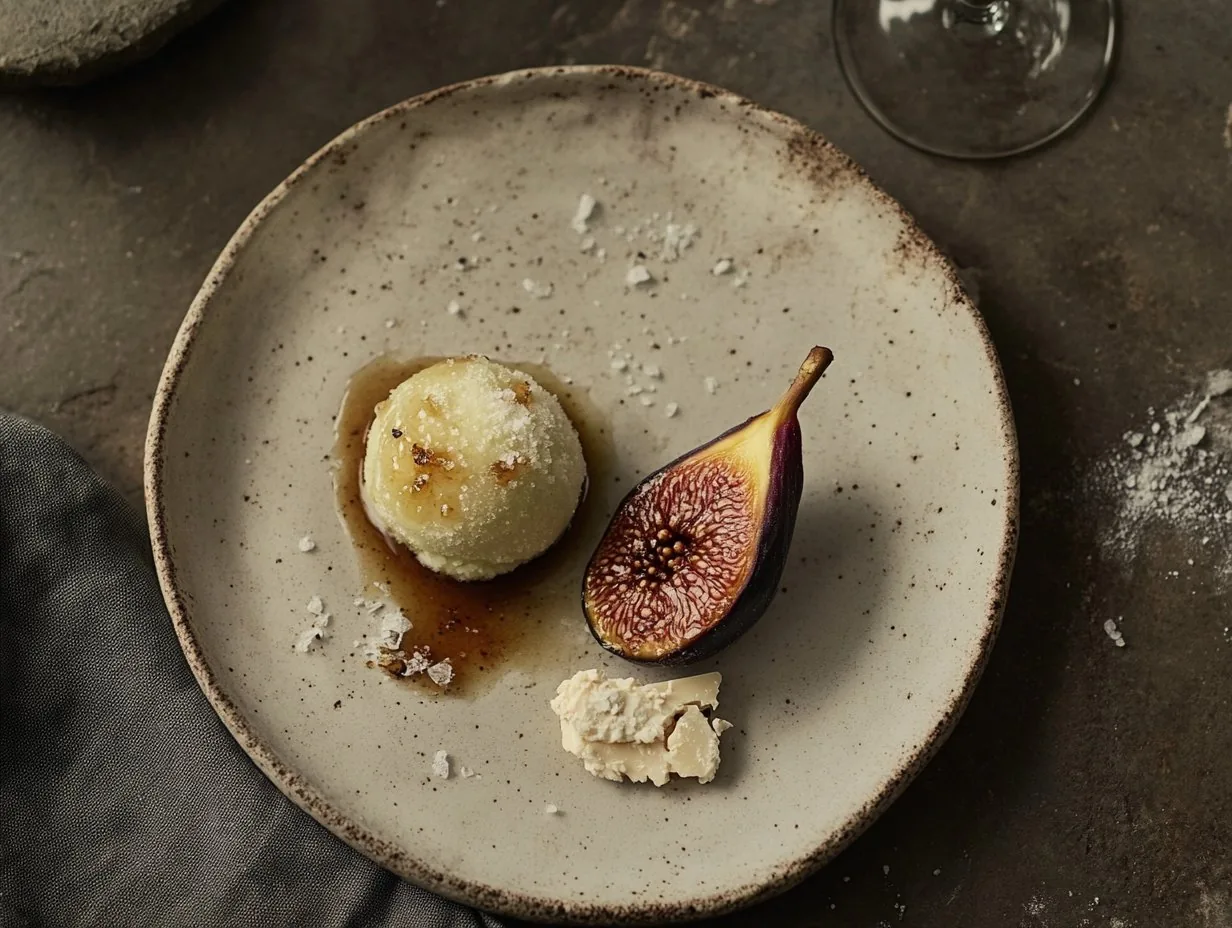
Jezgra ne treba da zasiti. Pitanje je jednostavno: šta ostane kad se skloni sve suvišno? To je Modus. Divlja smokva raste po ostrvima i u avgustu prezrela pada uz puteve. Za ovakav desert bolju namirnicu ne bih ni tražio.

Sorbet s maslinovim uljem i soli: prezrele smokve izblendirane sa malo šećernog sirupa, tako da se oseća voće, a ne šećer. Na kašiku sorbeta idu maslinovo ulje prvog ceđenja i fleur de sel: masnoća ulja, so i kiselost smokve. To je od Botture. Smokva karamelizovana brenerom, sa sirom sa ostrva: Maillardova reakcija na voću, kao kod Roce. Čips od lista: listovi smokve osušeni i pečeni, pa gost jede i biljku oko ploda, ne samo plod. To je od Redzepija.

Jezgra is not meant to fill you. The question is simple: what is left when everything unnecessary is taken away? That is Modus. Wild figs grow on the islands and fall overripe along the roads in August. For a dessert like this I wouldn't look for a better ingredient.

Sorbet with olive oil and salt: overripe figs blended with a little sugar syrup, so you taste the fruit, not the sugar. On a spoonful of sorbet go first-press olive oil and fleur de sel: the fat of the oil, salt, the acidity of the fig. That one is from Bottura. Fig caramelised with a torch, with island cheese: the Maillard reaction on fruit, as Roca does it. Leaf chip: fig leaves dried and baked, so the guest eats the plant around the fruit, not only the fruit. That one is from Redzepi.

sorbet with oilsorbet s uljemcaramelizedkaramelizovanaleaf chip
Bottura (minimum sugar, maximum fruit · Osteria Francescana) · Roca (Maillard na voću / on fruit) · Redzepi (celina biljke / whole plant)
A fig in season, and not much else.Smokva u sezoni, i ne mnogo više od toga.
▽
09

Talog

Conservation · What staysOdržanje · Šta ostaje
Olive oil · extra virgin · islandMaslinovo ulje · ekstra devičansko · ostrvsko
Talog

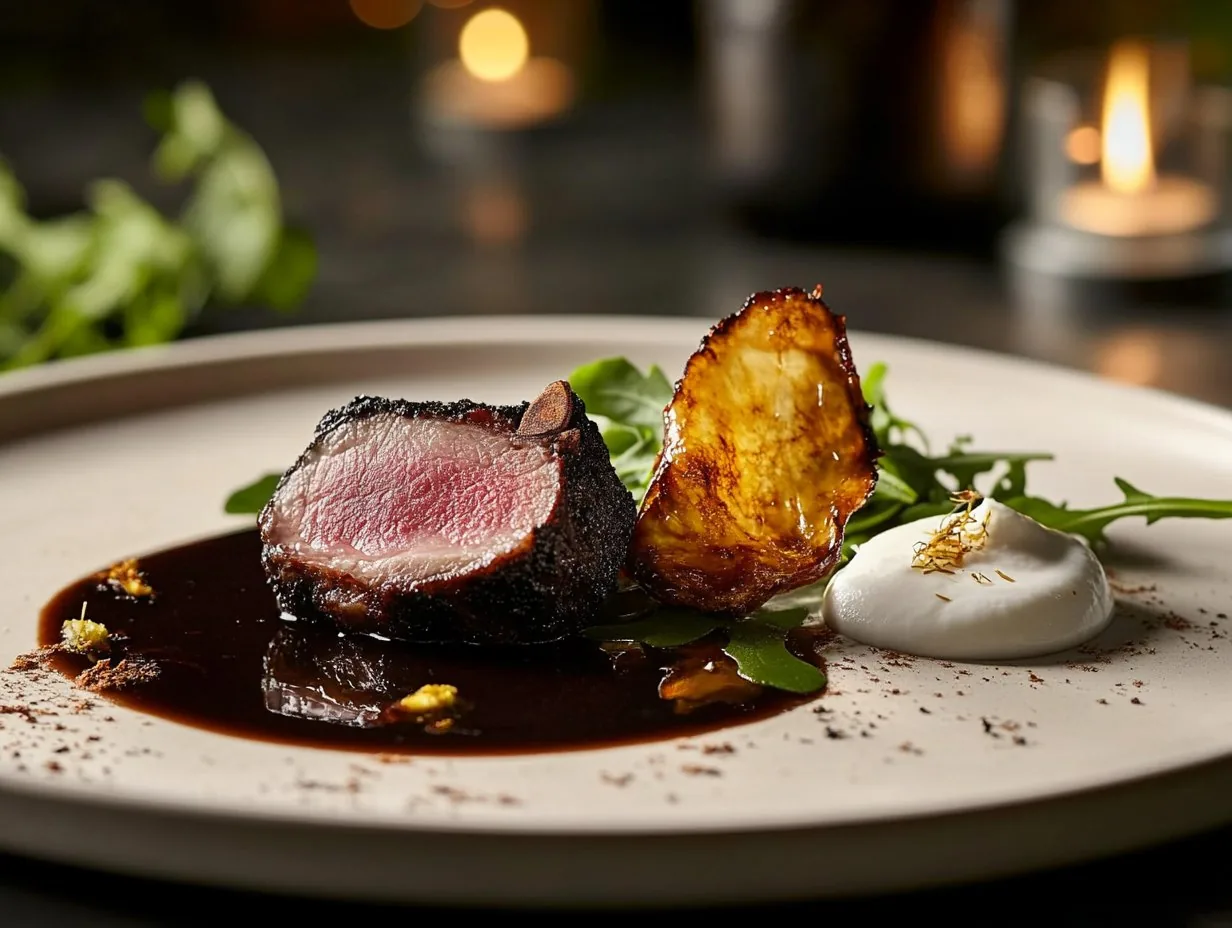
Poslednji hod dolazi bez najave. Osoblje ga tiho spusti na sto dok gosti još pričaju ili gledaju more, bez reči. Kartica iz Jezgre i dalje stoji na stolu. Maslinovo ulje je bilo u gotovo svakom hodu ove večeri: u fokači, u kremi od srdele, u tartaru i konfitu od zubaca, u umami redukciji uz Žaru i Patinu, u kremi od pepela, u sorbetu. Sada dolazi samo, u tri oblika. Ono što je bilo tu celo veče sada dobija ime.

Gelato od maslinovog ulja: ulje emulgovano u bazu od crème anglaise, obrađeno u Pacojetu. Zelenkast i kremast, a u prvom planu su travnat ukus, gorčina i ljutina ulja. Sferifikacija po Adrijinoj tehnici: tečno maslinovo ulje u tankoj opni od alginata, jede se u jednom zalogaju i odmah se istopi. Biskvit iz mikrotalasne: vazdušast, nestane u ustima i ostavi samo miris. Uz Talog dolazi kartica s rečenicom iz AsketCuisine beleški. Svake večeri je druga, pa gost koji dođe ponovo dobije novu.

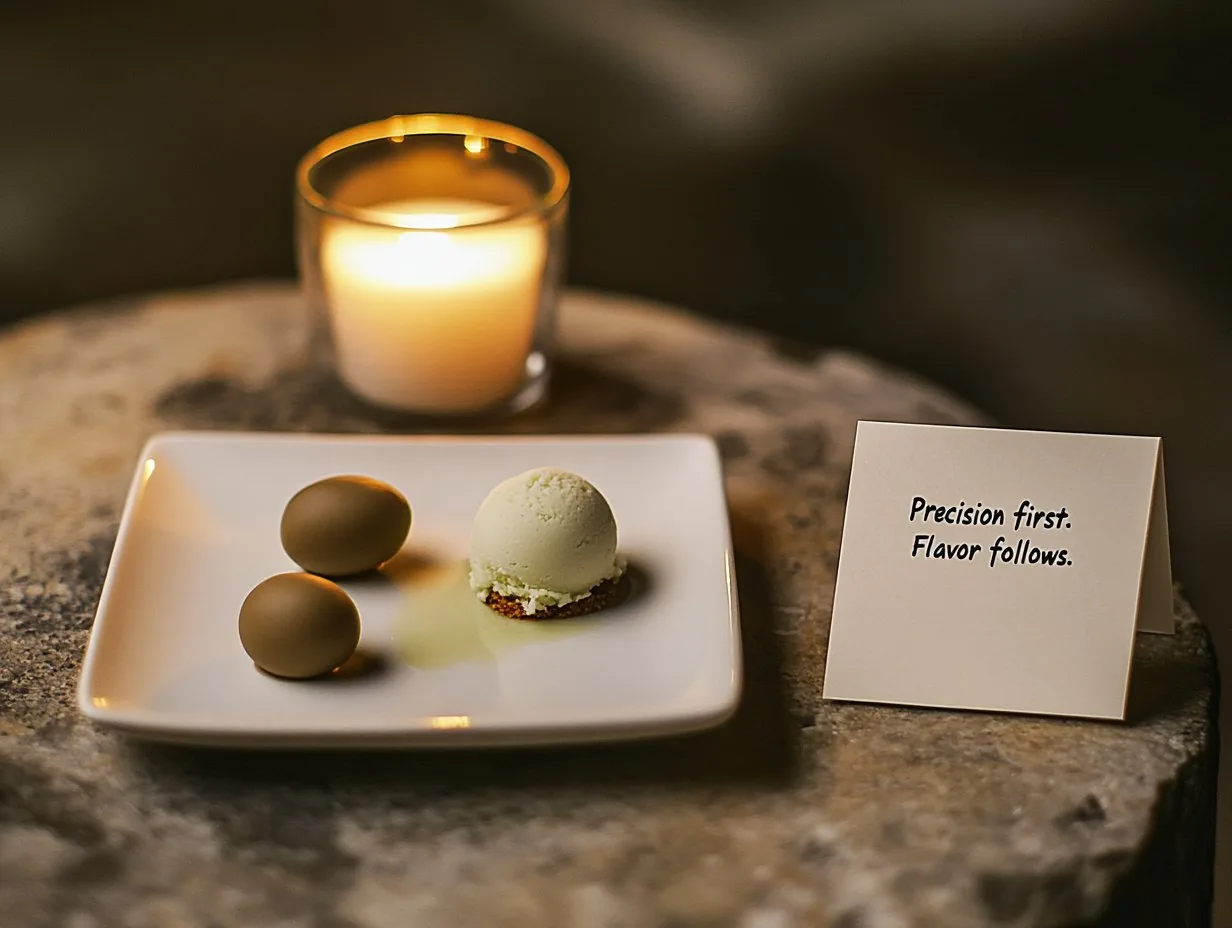
The last course arrives without announcement. Staff quietly set it down while guests are still talking or looking at the sea, without a word. The card from Jezgra is still on the table. Olive oil has been in almost every course of the evening: in the focaccia, the sardine cream, the dentex tartare and confit, the umami reduction for Žara and Patina, the ash cream, the sorbet. Now it comes on its own, in three forms. What was there all evening now gets a name.

Olive oil gelato: the oil emulsified into a crème anglaise base and spun in the Pacojet. Greenish and creamy, with the grassiness, bitterness and pepperiness of the oil up front. Spherification by Adrià's technique: liquid olive oil inside a thin alginate skin, eaten in one bite, melting at once. Microwave sponge: airy, gone in a moment, leaving only a scent. With Talog comes a card bearing a sentence from the AsketCuisine notes. It is different every evening, so a guest who comes back gets a new one.

gelatospherificationsferifikacijamicro spongemikro biskvit
Adrià / elBulli (sferifikacija 2003 / spherification 2003) · Bottura · Modernist Cuisine (mikrotalasni biskvit / microwave sponge)
At the end, what stays.Na kraju, ono što ostaje.

TechniqueTehnika
On referencesO referencama

Uz svaki hod navodim odakle tehnika potiče. Ferran Adrià je u elBulliju 2003. uveo sferifikaciju u kuhinju. Heston Blumenthal je mnogo radio sa kontrastom temperatura. Joan Roca je u sous-videu video način razmišljanja, a ne samo tehniku. Bittor Arginzoniz iz Asador Etxebarrija pokazuje da je vatra ponekad sav sos koji jelu treba. René Redzepi koristi biljku celu. Massimo Bottura stavlja malo šećera da bi voće bilo u prvom planu. Fergus Henderson je vratio kuvanje od glave do repa pre nego što je to postalo moda. Tehnika dolazi iz sveta, a namirnice su odavde.

With each course I note where the technique comes from. Ferran Adrià brought spherification into the kitchen at elBulli in 2003. Heston Blumenthal did a lot of work with temperature contrast. Joan Roca saw sous-vide as a way of thinking, not just a technique. Bittor Arginzoniz of Asador Etxebarri shows that fire is sometimes all the sauce a dish needs. René Redzepi uses the whole plant. Massimo Bottura keeps sugar low so the fruit comes first. Fergus Henderson brought back nose-to-tail cooking before it was fashionable. The technique comes from the world; the ingredients come from here.


Format & ReservationFormat i rezervacija
CapacityKapacitet
6 – 12
One table, one service. With fewer than six guests the numbers don't work and the room is too quiet. With more than twelve I can no longer notice who is eating more slowly, who is unsure about the dish in front of them, and when to say something with a course and when to keep quiet.Jedan sto, jedan servis. Za manje od šest gostiju računica ne izlazi, a veče je pretiho. Preko dvanaest više ne stižem da primetim ko jede sporije, ko nije siguran u jelo pred sobom, i kada treba nešto reći uz hod, a kada ćutati.
DatesTermini
2×
Twice a month, booked at least 48 hours ahead. Those 48 hours are for sourcing: the oysters have to be fresh, the octopus is bought the same morning, and the fennel from a local farm is picked the day before. Without that time I would have to change something, and you would taste it.Dva puta mesečno, uz rezervaciju najmanje 48 sati unapred. Tih 48 sati treba nabavci: kamenice moraju biti sveže, hobotnica se nabavlja istog jutra, a komorač iz lokalnog uzgoja bere se dan ranije. Bez tog vremena morao bih nešto da menjam, a to bi se osetilo na tanjiru.
DurationTrajanje
3 – 4h
The first three courses come every 18–20 minutes. The octopus, the fifth course, follows after a shorter gap of 12 minutes so the evening keeps its pace. The fennel comes almost right after it. The longest pause, 22–25 minutes, comes on purpose before the lamb. The fig and Talog come without hurry.Prva tri hoda dolaze na 18–20 minuta. Hobotnica, peti hod, dolazi posle kraćeg razmaka od 12 minuta, da veče ne izgubi zamah. Komorač ide gotovo odmah posle nje. Najduža pauza, 22–25 minuta, namerno je pred jagnjetinom. Smokva i Talog dolaze bez žurbe.
ReservationRezervacija
50%
A 50% deposit is paid when booking. Tell us then about allergies and anything you don't eat: the menu doesn't change at the table, but I can adapt any course in advance.Pri rezervaciji se uplaćuje depozit od 50%. Tada nam javite alergije i šta ne jedete: za stolom se meni ne menja, ali unapred mogu da prilagodim svaki hod.
Tasting MenuDegustacioni meni
120
EUR per person · nine courses
water and bread included
EUR po osobi · devet hodova
voda i hleb uključeni
Wine Pairing
+50
EUR per person · chosen for each courseEUR po osobi · biran uz svaki hod

The table: a bare surface, simple tableware without decoration, one candle per guest in a small oil lamp with aromatic herbs from the island. The kitchen can be seen, or at least heard. No flowers, no background music, no long speeches from the staff.Sto: neobrađena površina, jednostavno posuđe bez ukrasa, po jedna sveća za svakog gosta, u kandilu sa aromatičnim biljem sa ostrva. Kuhinja se vidi, ili bar čuje. Nema cveća, nema muzike u pozadini i nema dugih prezentacija osoblja.

Reserve a table →Rezervišite sto →